- FireStarters - The Nichefire Newsletter
- Posts
- Culture Isn't Context. It's a Data Source.
Culture Isn't Context. It's a Data Source.
Plus - a special offer for our subscribers

Nichefire Newsletter
May 15, 2026
Most teams treat cultural signals as qualitative backdrop, something to sense, not measure. This post is about what changes when you can actually track the acceleration of a cultural moment and map it against your development timeline.
The real problem isn't signal volume
Enterprise innovation teams already have syndicated research, social listening dashboards, consumer panels, and category observation.
That surfaces more territories than can be resourced. The gap isn't what to pursue. It's timing confidence, knowing which opportunities are urgent and which can wait eighteen more months.
Without that, pipelines default to a few predictable failure modes: overcommitting to mainstream trends that are already commoditized by launch, underinvesting in emerging signals because there isn't enough quantified evidence to justify the resource ask, or spreading across too many territories because all of them look roughly equal on a static snapshot.
Bottom line:
By the time a behavior is searchable at scale, it's visible to every competitor with a social listening tool. The strategic window lives upstream.

Nichefire provides objective cultural analysis of the topics on your radar. Type in something you're seeing in your feed and see whether it’s signal or just noise.
What "predictive" actually means here
The distinction that matters is whether you're forecasting behavioral confirmation, what consumers will do given what they're already doing, or cultural momentum, which emerging conversations are compounding upstream of behavior.
Most syndicated tools do the former. They confirm trends you've already identified. Cultural momentum forecasting cross-references discourse signals (what people are saying across platforms and communities), intent signals (what they're searching for), and influence signals (what media and podcasts are beginning to shape broader attention).
The goal isn't to track a keyword, it's to find the cultural current before it becomes one.
Four places it changes the decision
Use case 1 - Prioritizing the innovation pipeline
When a team has eight potential territories, the question isn't which ones are real — most are real at some level. The question is which ones have an acceleration curve that matches your development timeline. A signal compounding at 65% week-over-week in niche communities has different urgency than one growing at 8% across mainstream channels. The former might close its window in six months. The latter might offer three years of runway.
When it changes the decision: When two territories look equally compelling on qualitative grounds and resource allocation has to go one direction. The acceleration data breaks the tie.
Use case 2 - Timing go-to-market against cultural lifecycles
Launching too early means educating a market that isn't ready. Launching too late means competing on price in a category that's already crowded.
The optimal window is predictable, but only if you can measure where a cultural moment sits in its lifecycle: emerging, surging, peaking, or plateauing. A brand that spots a signal while it's still niche can build and validate over twelve months, then enter as it crosses into mainstream acceleration.
When it changes the decision: Campaign and launch timing. The data gives marketing and innovation a shared reference point for when to accelerate, rather than gut feel or sales confirmation that always comes too late.
Use case 3 - Reframing what category a signal belongs to
Surface-level monitoring assigns signals to categories. "Traveling with children" gets filed under travel. "Hot pot culture" gets filed under food service.
The natural response: act on it if you're in that category, ignore it if you're not.
Cultural analysis does something different — it extracts the emotional driver underneath. "Traveling with children" is actually about multigenerational reconnection and shared experience over individual status. Suddenly it's relevant to financial services, CPG, auto brands, and home brands. The TAM just expanded.
When it changes the decision: When a team is deciding whether a signal is "in our category." The cultural layer removes the category filter and reveals relevance a surface read would miss.
Use case 4 - Building the business case for early investment
Enterprise organizations are low-risk environments by definition. Presenting an emerging niche signal as "this is going to be big" requires more than conviction, it requires quantified trajectory. A signal growing at 29% week-over-week with Reddit conversation up 700% and TikTok spikes across three distinct communities is a different ask than "we're seeing some interesting stuff in niche spaces." The numbers give innovation leads the credibility to request resources before the opportunity is obvious.
When it changes the decision: Budget allocation in Q-planning cycles. The quantified case shortens the approval path.

The biggest CPG and pharma giants you know of use Nichefire - now we’re offering a smaller way in to our beehiv audience. Start with a free trial → expand to something so much more accessible.
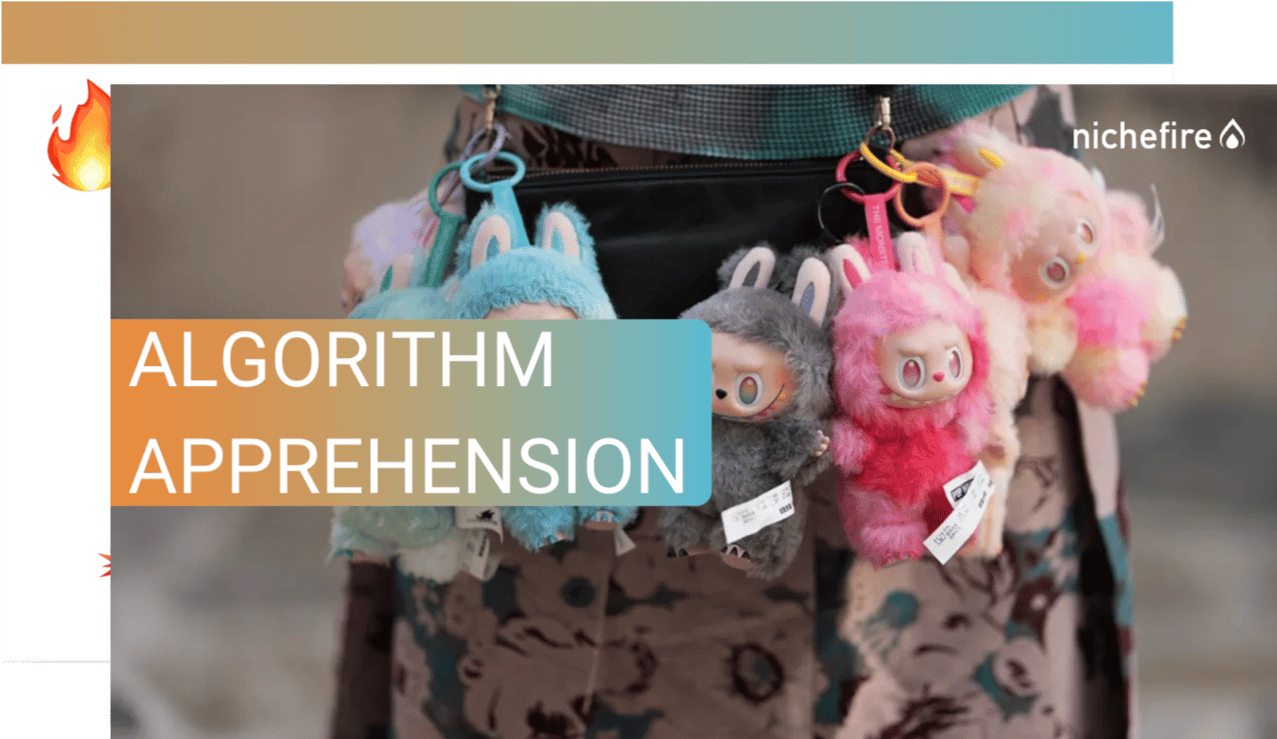
Case Study: “Algorithm Apprehension”
Let’s break this down using the Algorithm Apprehension movement as an example. (Access the deck here)
Algorithm Apprehension is a signal that surfaces across three distinct content streams simultaneously: backlash against AI-generated creative output (Taylor Swift's The Life of a Showgirl called out for "pushing algorithm-pleasing output over genuine artistry"), mounting criticism of biased and unchecked AI platforms (Gemini, Sora, Grok), and Gen Z's analog turn — film photography, ceramics, IRL book clubs, ghost-scrolling.
A surface read files these separately. AI ethics goes to a tech team. Taylor Swift discourse goes to entertainment. Analog lifestyle goes to wellness or CPG. None of them look like the same signal.
The cultural read sees one driver underneath all three: consumers want to curate, not be curated. They are actively resisting the feeling that their tastes, identities, and feeds have been algorithmically assigned to them. That driver is not category-specific. It's a tension that touches every brand that markets through digital channels.
Bottom line…
Predictive analytics improves product innovation strategy in one specific way: it replaces timing guesswork with timing evidence. It doesn't generate the ideas.
It doesn't replace the judgment of the innovation team. It adds the one thing most enterprise teams are missing, confidence in when the window opens, not just that an opportunity exists.